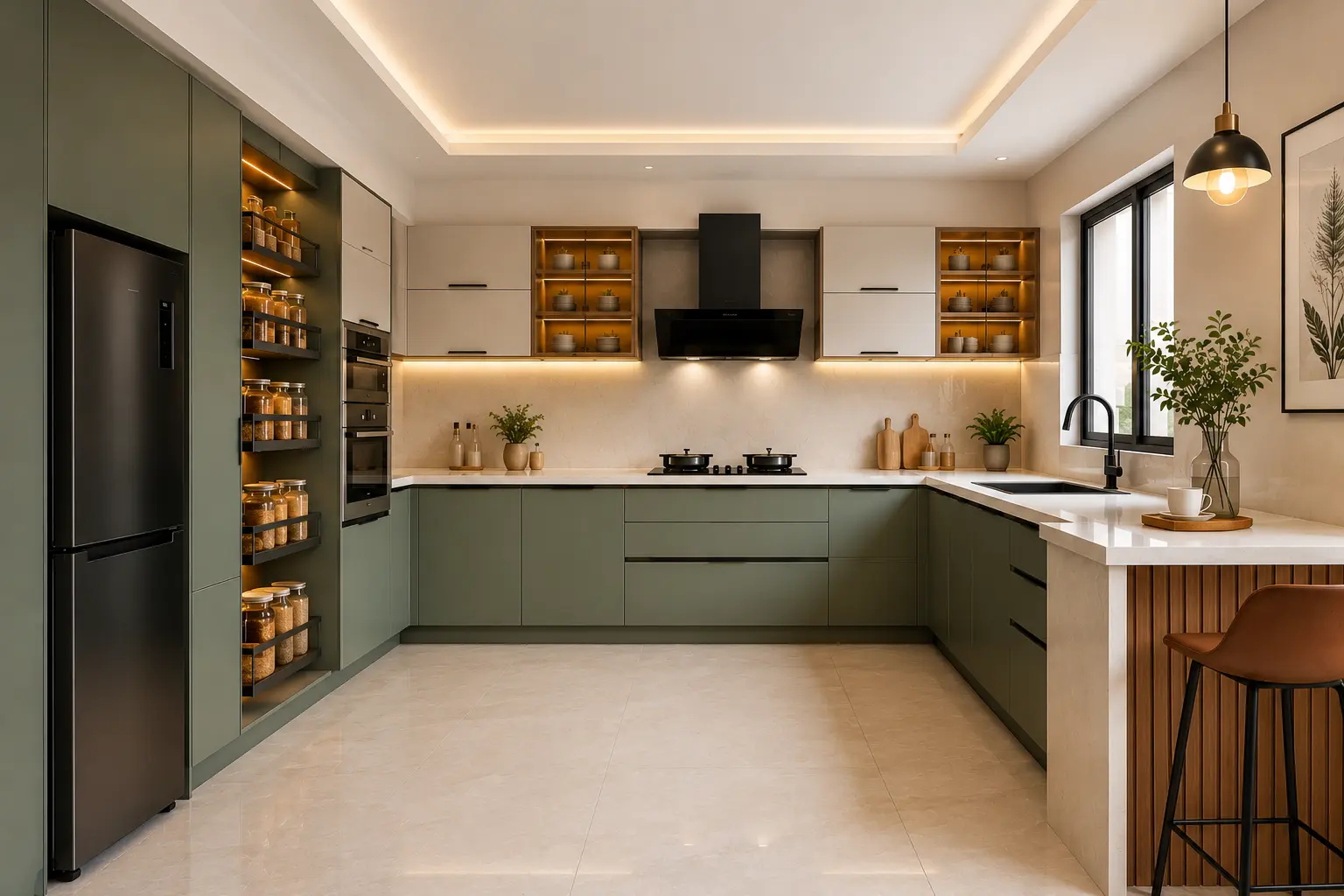
A kitchen island is no longer a luxury reserved for sprawling homes. With the right design approach, even the most compact Indian kitchen can benefit from the storage, prep space, and style that an island brings. At Almac Modular Kitchens & Interiors, we have been helping homeowners across Delhi, Gurgaon, Dwarka, Rohtak, and Hisar transform small kitchens into highly functional, beautifully designed spaces since 2010.
In this guide, we share the most practical, space-conscious kitchen island ideas for small kitchens — from movable carts to built-in modular designs, along with expert tips on layouts, materials, ventilation, and why the right design partner makes all the difference.
TL;DR
A kitchen island can work in a small Indian kitchen when the layout is planned correctly. Maintain at least 90 cm of clearance around the island, choose a design that suits your available space, and prioritise storage and workflow. Rolling islands, foldable islands, breakfast bars, and peninsula designs are excellent options for compact homes. If you plan to install a cooktop on the island, include an island chimney for effective ventilation.
What Is a Kitchen Island?
A kitchen island is a freestanding or built-in counter unit positioned at the centre or periphery of a kitchen, separate from the main cabinetry walls. It provides additional workspace, storage, seating, and utility, often becoming the most-used zone in the entire kitchen. Kitchen islands are ideal for homeowners who cook frequently, need extra storage, or want a casual dining surface without a separate dining table.
In modular kitchen design, islands are integrated as a planned component of the overall layout, with plumbing, electrical, or ventilation built into the unit itself.
Kitchen Island vs. Kitchen Peninsula: What's the Difference?
Many homeowners confuse a kitchen island with a peninsula. Here is a clear comparison:
|
Feature |
Kitchen Island |
Kitchen Peninsula |
|
Attachment |
Freestanding – not connected to walls |
Connected to one wall or cabinet run |
|
Access |
Accessible from all four sides |
Accessible from three sides |
|
Space needed |
More floor space required |
Works in tighter kitchens |
|
Best for |
Larger open-plan kitchens or well-planned small kitchens |
L-shaped or U-shaped compact kitchens |
|
Flexibility |
Can be movable or fixed |
Always fixed |
|
Utility |
More versatile — seating, cooking, storage |
Strong on storage and prep |
Almac's recommendation: For most small Indian kitchens, a peninsula or a slim island is the smarter choice. However, with precise modular planning, a compact island absolutely works — and the results are stunning.
Is a Kitchen Island Possible in a Small Kitchen?
Yes — a kitchen island is entirely possible in a small kitchen, provided you plan the layout carefully and choose the right island size and type. The key is ensuring adequate clearance around the island so the kitchen remains comfortable to move around and use.
Many homeowners assume islands are only for large kitchens. That assumption is outdated. Modern modular design, smart material choices, and space-optimised island formats have made islands accessible to compact kitchens in 2BHK and 3BHK apartments across India.
At Almac, our designers regularly incorporate thoughtfully sized islands into kitchens as compact as 90 sq. ft., without compromising workflow or storage.
Minimum Space Required for a Kitchen Island in India
According to standard kitchen ergonomics and building design guidelines, here are the minimum clearances required to safely install a kitchen island:
-
Minimum clearance on each side of the island: 90 cm (approximately 3 feet)
-
Ideal clearance for comfortable two-person movement: 105–120 cm
-
Minimum island size for functional use: 60 cm wide × 90 cm long
-
Recommended island size for Indian kitchens: 75 cm wide × 120 cm long
If your kitchen cannot accommodate 90 cm of clearance on at least two sides, a peninsula design or a rolling/movable island is a better fit. Our Almac design consultants will assess your kitchen dimensions during the free consultation and recommend the most suitable solution.
Best Kitchen Island Designs for Small Modular Kitchens in India
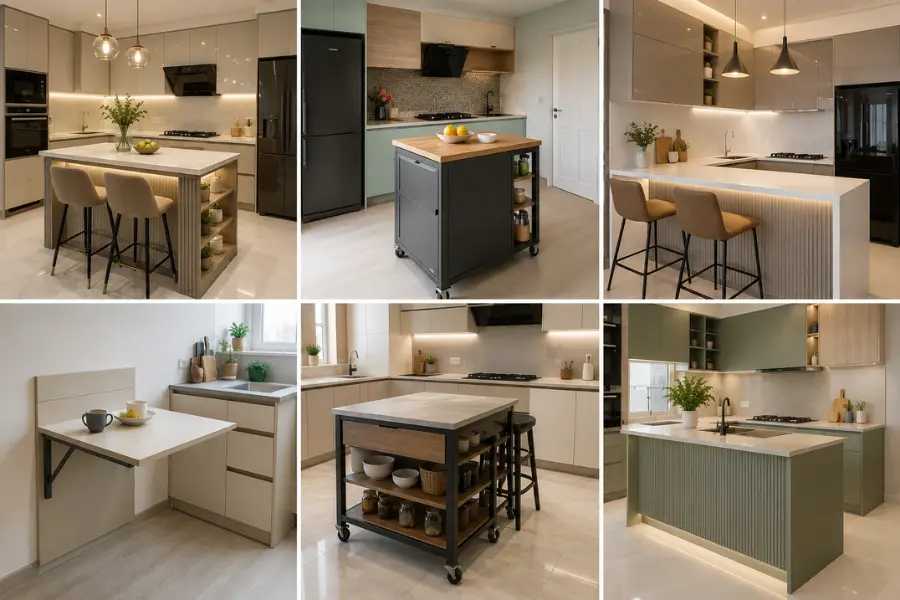
Here are six tried-and-tested kitchen island ideas that work beautifully in small Indian kitchens. Each has been implemented by the Almac design team across projects in Delhi and Gurgaon.
1. Rolling or Movable Kitchen Islands
A rolling island is a freestanding unit mounted on lockable castor wheels, giving you the flexibility to move it when needed and tuck it away when the kitchen feels crowded.
Why it works for small kitchens: You are not committing permanent floor space to a fixed structure. The island serves as a prep counter, storage unit, or serving trolley — and rolls out of the way when you need more room.
Best for: Studio apartments, compact single-wall kitchens, and homeowners who are renting and cannot modify the kitchen permanently.
Almac design tip: We recommend pairing a rolling island with a butcher-block or compact quartz top in a contrasting finish to the main cabinetry. It adds visual interest without visual clutter.
2. Foldable / Drop-Leaf Island Designs
A drop-leaf island features one or two hinged countertop extensions that fold down flat when not in use. When you need extra prep or dining space, you simply lift the leaves into position.
Why it works for small kitchens: The footprint shrinks dramatically when the leaves are folded, making this one of the most space-efficient island formats available.
Best for: Kitchens that double as dining spaces in 1BHK or compact 2BHK flats.
Design tip: We design drop-leaf islands with internal drawer storage, so the unit is functional even in its compact, folded state. Choose a matte lacquered finish to keep the unit looking sleek and modern.
3. Slim Breakfast Bar Islands
A slim breakfast bar island is a narrow, elongated island — typically 40–50 cm deep — that provides a counter-height surface for quick meals, tea, or prep work. Stools tuck neatly underneath when not in use.
Why it works for small kitchens: The slim depth means the island does not consume much floor space laterally, while the length gives you a generous work surface. It replaces the need for a separate dining table, freeing up the rest of the home.
Best for: Open-plan kitchen-living rooms, modern apartments where the kitchen faces the living space.
Design tip: Match the breakfast bar surface to your kitchen countertop material for a seamless, built-in aesthetic. We recommend a 3 cm thick sintered stone or compact quartz slab for durability and impact.
4. Built-in Storage Island with Pull-Out Drawers
For homeowners who need maximum storage above all else, a built-in storage island with floor-to-ceiling or base-to-counter pull-out drawers is the ideal solution. Every centimetre of the island serves a storage purpose.
Why it works for small kitchens: Small kitchens suffer from storage deficits. A dedicated storage island compensates by housing everything from pots and pans to spice organisers and waste bins — keeping the main cabinets clutter-free.
Best for: Families who cook Indian meals daily and need accessible, well-organised storage for a high volume of vessels and ingredients.
Design tip: We incorporate pull-out carousels, deep drawer organisers, and a built-in bin system into our storage islands. The result is a kitchen that functions like a professional space, even in a modest footprint.
5. L-Shaped Kitchen with Mini Island Extension
In an L-shaped kitchen layout, a compact island can be positioned at the open end of the 'L' to create a U-shaped workflow — one of the most ergonomically efficient kitchen configurations in the world.
Why it works for small kitchens: The island effectively extends the work triangle without requiring a major renovation. It creates a natural boundary between the cooking zone and the rest of the living space.
Best for: L-shaped kitchens in 2BHK and 3BHK apartments where there is an open wall opposite the main kitchen run.
Design tip: The island should mirror the depth of the main cabinetry (60 cm) and be finished in the same colour palette. Add pendant lighting directly above the island to define the zone and elevate the aesthetics.
6. Peninsula-Style Island for Galley Kitchens
A peninsula is technically a connected island — attached to one wall or cabinet run and open on three sides. For narrow galley kitchens, it is often the most practical "island-style" solution, as it does not require floor space on all four sides.
Why it works for small kitchens: It brings all the functional benefits of an island — extra prep space, seating, storage — without demanding the clearance that a true freestanding island requires.
Best for: Galley-style kitchens in older Delhi apartments, narrow kitchens in independent houses.
Design tip: Design the peninsula with a raised breakfast bar on the living-room side and standard counter height on the kitchen side. This gives you two distinct surface levels and a natural visual divider between kitchen and living areas.
Kitchen Island Designs for Small Indian Kitchens – Layout Comparison
Island Kitchen Layout: How It Differs from L-Shaped and U-Shaped Kitchens
Not all kitchen layouts accommodate an island equally well. Here is how the most popular modular kitchen layouts in India compare when an island is introduced:
|
Layout |
Can It Accommodate an Island? |
Minimum Kitchen Size |
Almac's Recommendation |
|
Straight / Single Wall |
With rolling or peninsula only |
80+ sq. ft. |
Rolling island or breakfast counter |
|
L-Shaped |
Yes, with mini island at open end |
100+ sq. ft. |
Fixed or movable compact island |
|
U-Shaped |
Rarely — already high on counter space |
120+ sq. ft. |
Skip island; use peninsula instead |
|
Parallel / Galley |
Yes, as a peninsula only |
90+ sq. ft. |
Peninsula with seating on living-room side |
|
Open Plan |
Best candidate for a true island |
130+ sq. ft. |
Full island with storage, seating, and utility |
How Almac Customises Island Kitchen Layouts for Delhi & Gurgaon Homes
Homes across Delhi NCR come in a wide range of configurations, from compact DDA flats in Dwarka to open-plan luxury apartments in Gurgaon. Almac's design process begins with a precise on-site measurement and a detailed discussion about how the kitchen is actually used daily.
Our designers then create a 3D layout that integrates the island organically into the existing space, accounting for door swings, appliance positions, window placements, and electrical points. We do not apply a template. Every kitchen we design is bespoke to the home and the family that lives in it.
Space-Saving Tips for Small Kitchens with Islands – The Almac Approach
Material and Finish Choices That Make Small Kitchens Feel Larger
The materials you choose for your island have a direct impact on how spacious the kitchen feels:
-
Light-coloured countertops (white, cream, light grey quartz) reflect light and make the island feel less imposing.
-
High-gloss or lacquered cabinet finishes bounce light around the room, creating a sense of depth.
-
Open shelving on one side of the island reduces visual mass and offers accessible everyday storage.
-
Matching the island finish to the floor creates a seamless visual flow, making the kitchen appear larger.
-
Handleless cabinet doors on the island keep the design uncluttered and the lines clean.
At Almac, we use premium materials including marine-grade plywood, European-imported hardware, and ISI-certified laminates — so your kitchen not only looks beautiful but also withstands the demands of Indian cooking and climate.
Smart Storage Add-Ons: Pull-Outs, Carousels & Vertical Shelving
A well-designed island does far more than provide a flat surface. The Almac team integrates the following smart storage solutions into every island design:
-
Deep pan drawers for storing large kadais, pressure cookers, and baking trays flat, rather than stacking them.
-
Pull-out waste bin units to keep the kitchen hygienic and the floor clear.
-
Spice pull-outs on one side of the island — narrow, vertical drawers with tiered racks, accessible right at the cooking zone.
-
Bottle pull-outs for oils, vinegars, and frequently used liquids.
-
Under-counter microwave or oven housing integrated into the island base, freeing up countertop space on the main platform.
Lighting Tricks to Enhance a Small Kitchen Island
Lighting transforms a kitchen island from a functional box into a design statement. These three lighting strategies work especially well in compact kitchens:
-
Pendant lights above the island — 2 to 3 slim pendant lights hung 70–75 cm above the countertop create a focal point and define the island zone without visually overwhelming the space.
-
Under-cabinet LED strips on the island's overhang (if a breakfast bar is included) bathe the seating side in warm light, ideal for evenings.
-
Recessed ceiling lights directly above the island for functional task lighting during cooking.
Almac's interior design team coordinates lighting placement as part of the kitchen design process, ensuring electrical points are planned before civil work begins.
Kitchen Island Chimney – Complete Guide for Island Kitchen Ventilation
What Is an Island Kitchen Chimney?
An island kitchen chimney (also called a ceiling-mounted or suspended chimney) is a ventilation hood that hangs directly from the ceiling above a kitchen island cooktop, rather than being mounted against a wall. It draws smoke, steam, grease, and odours upward and exhausts them through a duct that runs within the ceiling or is concealed behind a decorative housing.
Island chimneys are a non-negotiable accessory when a cooktop is installed on the kitchen island. Without adequate ventilation, cooking smoke spreads throughout the home and causes lasting damage to cabinetry and ceilings.
Island Chimney vs. Wall-Mounted Chimney: Which Is Better for Small Kitchens?
|
Feature |
Island Chimney |
Wall-Mounted Chimney |
|
Mounting position |
Ceiling / suspended |
Wall above the hob |
|
Best for |
Island cooktops |
Wall or counter-mounted hobs |
|
Aesthetic impact |
High — becomes a visual centrepiece |
Functional, less prominent |
|
Suction capacity needed |
Higher (1000+ m³/hr) due to open position |
Moderate (600–900 m³/hr) |
|
Ducting complexity |
Higher — runs through ceiling |
Simpler — runs along the wall |
|
Cost |
Higher |
More affordable |
Verdict: If your island has a cooktop, an island chimney is essential. If your cooktop stays on the wall counter and the island is for prep and storage only, a wall chimney suffices. Almac helps clients plan the cooktop position and chimney type together, before any civil work begins.
Key Features to Look for in an Island Kitchen Chimney
When selecting an island chimney for a small kitchen, prioritise the following:
-
Suction power of 1000–1200 m³/hr — island chimneys need stronger suction because they are exposed to cross-ventilation from all sides.
-
Auto-clean function — reduces manual maintenance and keeps suction efficiency high over time.
-
Motion sensor or gesture control — convenient when your hands are occupied while cooking.
-
Baffle filters — far more efficient than mesh filters for Indian cooking, which generates heavy oil and masala fumes.
-
Noise level under 58 dB — critical in open-plan kitchens where the chimney is audible from the living room.
-
Slim or designer body — since island chimneys are visible from all angles, the aesthetic of the unit matters significantly.
How Almac Integrates Chimneys Into Island Kitchen Designs
At Almac, chimney planning is part of the kitchen design process — not an afterthought. Our team coordinates with the civil contractor to ensure:
-
Ceiling ducts are concealed within a false ceiling or purpose-built chimney housing that complements the kitchen aesthetic.
-
Electrical points are positioned precisely above the island during the civil phase, before tiles and ceiling work begin.
-
Chimney height and island size are proportional — the chimney hood should ideally be 15–20 cm wider than the cooktop on all sides for maximum capture efficiency.
-
Brand selection aligns with your budget — we advise on chimney brands that offer the best performance-to-cost ratio for your specific kitchen configuration.
Why Almac Modular Kitchens & Interiors Is the Right Choice for Your Island Kitchen
End-to-End Design, Project Management & Installation – Under One Roof
Designing a kitchen island is not just about choosing a countertop material. It involves spatial planning, electrical and plumbing coordination, civil work supervision, cabinetry fabrication, appliance integration, and installation — all of which must be sequenced precisely and executed without error.
Almac provides a fully integrated, single-point service that covers every stage — from the initial design consultation and 3D visualisation to material selection, fabrication at our manufacturing unit, and supervised on-site installation. You never need to coordinate separately with an architect, a contractor, and a kitchen vendor. We handle it all.
Customised Modular Solutions for Every Home Size and Budget
No two Almac kitchens are identical. We specialise in fully customised modular solutions that are designed around your specific home dimensions, cooking habits, aesthetic preferences, and budget.
Our kitchen range includes L-shaped, U-shaped, G-shaped, straight/inline, and parallel layouts, all of which can incorporate island or peninsula elements depending on the available space. We work with premium materials including European-imported hardware, ISI-certified marine plywood, and a wide selection of laminates, lacquers, PU finishes, and natural stone countertops.
Whether you have a budget of ₹2 lakhs or ₹20 lakhs, Almac designs kitchens that deliver maximum value without compromise on quality or durability.
Conclusion
A kitchen island is one of the most impactful upgrades you can make to a small kitchen. It adds prep space, storage, and a social focal point, all without requiring a major structural renovation. The key is choosing the right type of island for your space, planning the layout with precision, and partnering with a design team that understands how Indian families actually cook and live.
At Almac Modular Kitchens & Interiors, we bring together thoughtful design, quality craftsmanship, and end-to-end project management to deliver island kitchens that are as practical as they are beautiful. From Delhi to Gurgaon and beyond, we have helped hundreds of families transform their kitchens, and we are ready to help you too.
Ready to get started? Book a free kitchen design consultation with Almac today.
Frequently Asked Questions
Q1. What is a kitchen island and what are its uses?
A kitchen island is a freestanding or built-in counter unit placed in the centre or open area of a kitchen, separate from the main wall cabinets. It provides additional workspace for food preparation, extra storage through drawers and shelves, casual dining space, and can house appliances or a second sink. It is one of the most versatile features in a modern modular kitchen.
Q2. Can you add a kitchen island to a small kitchen?
Yes, a kitchen island can be added to a small kitchen if you maintain a minimum clearance of 90 cm on at least two sides of the island. For very compact kitchens, movable rolling islands, foldable drop-leaf designs, or slim breakfast bars are the most practical options. Almac's design team regularly installs islands in kitchens as compact as 90 sq. ft. across Delhi NCR.
Q3. How much space is needed for a kitchen island?
A minimum clearance of 90 cm (3 feet) is needed on each working side of a kitchen island. The island itself should be at least 60 cm wide and 90 cm long to be functionally useful. For comfortable two-person movement and cooking, aim for 105–120 cm of clearance around the island.
Q4. What is the best kitchen island design for a small Indian home?
For small Indian kitchens, the best options are: a rolling/movable island for maximum flexibility; a slim breakfast bar island (40–50 cm deep) for open-plan kitchens; a drop-leaf foldable island for very tight spaces; or a mini island extension on an existing L-shaped kitchen layout. The right choice depends on your kitchen's specific dimensions, layout, and daily usage — Almac recommends a professional design consultation before deciding.
Q5. What is an island kitchen chimney and do I need one?
An island kitchen chimney is a ventilation hood suspended from the ceiling directly above a cooktop on a kitchen island. It draws cooking fumes, grease, and smoke upward and exhausts them through ceiling ducting. If your kitchen island has a cooktop, an island chimney is essential. If the island is used only for prep and storage (with the cooktop on the wall counter), a standard wall-mounted chimney is sufficient.
Q6. Which kitchen island layout works best for 2BHK flats in India?
For 2BHK flats in India, an L-shaped kitchen with a compact mini island at the open end is the most popular and practical configuration. It creates an efficient U-shaped work triangle, provides extra prep space, and adds storage without overwhelming the kitchen. A peninsula design is a close second, particularly for kitchens that open into the living room.
-
Modular Kitchen Cost in Gurgaon: Budget, Hidden Charges & Pr..
-
Top 5 Modular Kitchen Manufacturers in Delhi..
-
Top 10 Modular Wardrobe Manufacturers in Gurgaon (2026 Guide..
-
12 Modern Walk-In Wardrobe Ideas for Master Bedrooms (2026 G..

-
8 Contemporary Kitchen Cabinets to Elevate Your Home in 2026..
-
7 Things to Know Before Hiring a Modular Kitchen & Interior ..
-
Luxury Italian Modular Kitchens in Gurgaon: A Complete Desig..
-
Small Bedroom Wardrobe Design Guide: Maximise Space & Storag..
-
Kitchen Island Ideas for Small Kitchens in India: Designs, L..

-
L-Shaped Modular Kitchen: Complete 2026 Guide to Smart Desig..