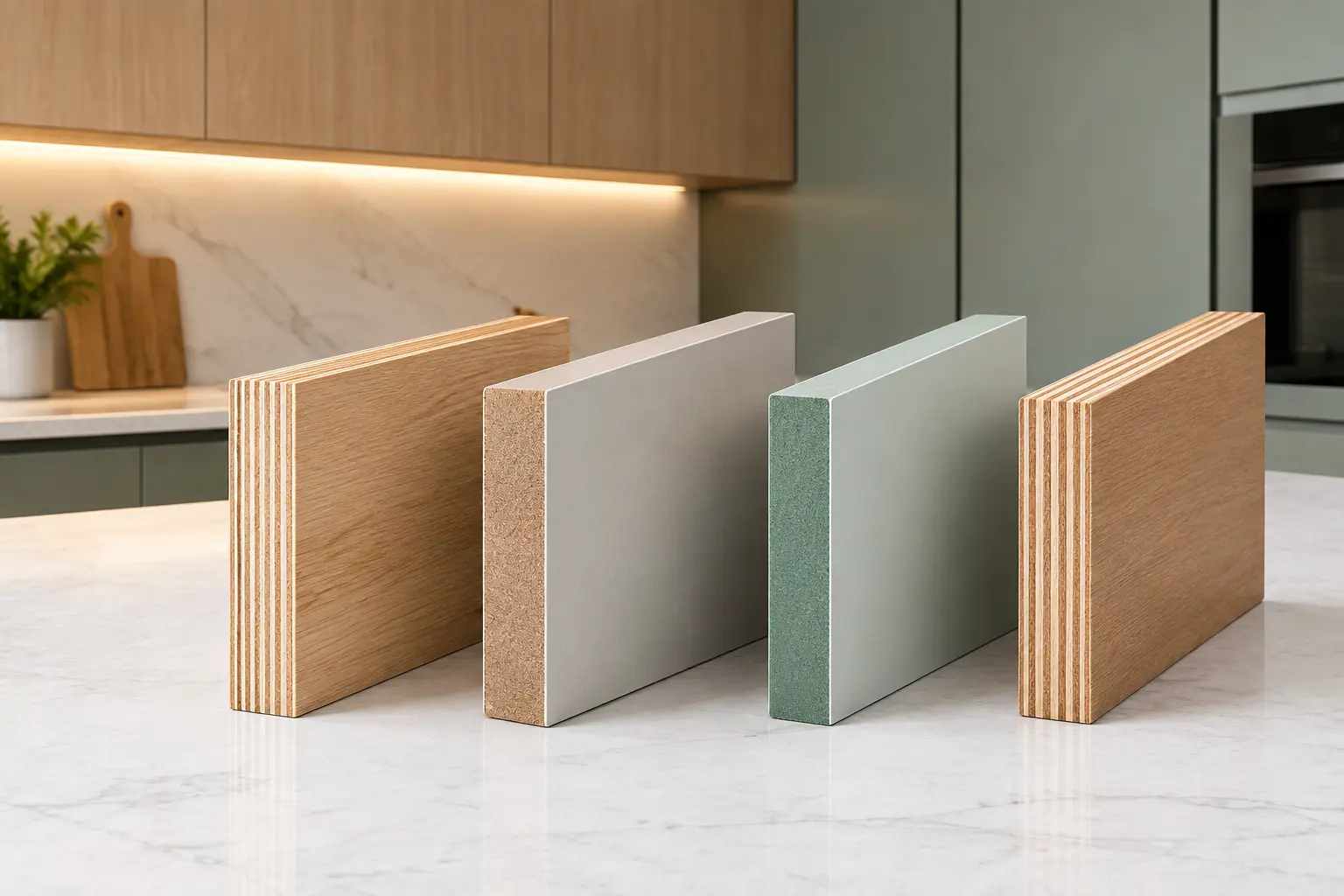
If you've started planning a modular kitchen, you've probably already run into four letters that decide almost everything about how your kitchen will look, feel, and hold up over time: plywood, MDF, HDHMR, and BWP. Every carpenter, dealer, and design catalogue throws these terms around, but very few explain what they actually mean for your daily cooking, your monsoon-heavy summers, or your wallet five years down the line.
This guide breaks down each material in plain language, compares them head-to-head, and tells you exactly where each one belongs in an Indian kitchen, so you're not relying on a salesperson's word when you're spending lakhs on your home.
Quick answer: For most Indian homes, a combination works best, BWP or MR-grade plywood for the cabinet carcass (the structural base that faces moisture) and HDHMR or MDF for the shutters (the visible doors and panels). The exact mix depends on your budget, your kitchen's exposure to water, and the finish you want. We'll explain why below.
Why Material Selection Matters for Indian Kitchens
Indian kitchens are not gentle environments. Between the humidity of coastal cities, the extreme heat of North Indian summers, monsoon moisture in Delhi-NCR and beyond, daily steam from cooking, and the sheer weight of vessels being pulled in and out of cabinets every day, a modular kitchen goes through more stress in a year than most furniture sees in a decade.
A few realities that make material choice non-negotiable in India:
-
Humidity and moisture cause cheap boards to swell, delaminate, or warp within a couple of years.
-
Termites are a real risk in many regions, especially with untreated or low-grade wood-based boards.
-
Daily wear — hinges, drawer channels, and constant opening/closing, demands strong screw-holding capacity from the core material.
-
Upfront cost vs long-term cost — a cheaper board today can mean a full kitchen replacement in 5–7 years, while a slightly higher investment now can easily last 12–15 years.
This is exactly why understanding plywood, MDF, HDHMR, and BWP — not just their names, but their actual performance, is the single most important decision in your kitchen planning process.
Also Read: Top 10 Modular Kitchen Designs in Gurgaon (2026)
Plywood for Modular Kitchens
What it is: Plywood is made by gluing together thin layers (veneers) of wood, each layer placed at a right angle to the one below it. This cross-layering is what gives plywood its strength and resistance to warping.
For kitchens, plywood typically comes in three grades:
-
MR (Moisture Resistant) grade — suitable for dry, low-moisture areas.
-
BWR (Boiling Water Resistant) grade — a step up, tolerates occasional water exposure.
-
BWP (Boiling Water Proof) grade — the toughest, built for constant moisture (covered in detail below).
Pros of plywood:
-
Excellent strength and screw-holding capacity
-
Handles heavy loads (utensils, appliances) without sagging
-
Naturally more resistant to impact and chipping than particle-based boards
-
Long service life when the correct grade is used
Cons of plywood:
-
Higher cost, especially in branded, ISI-marked variants
-
Quality varies significantly between manufacturers — an unbranded "plywood" can be far weaker than it looks
-
Surface needs veneer/laminate finishing, as raw plywood isn't visually premium on its own
Best use in a kitchen: Cabinet carcasses (the box structure), base units, and areas directly under the sink or near the water inlet, where moisture exposure is highest.
Read More: Best Kitchen Cabinet Materials in India (2026) | BWP Plywood vs HDHMR
MDF (Medium-Density Fibreboard)
What it is: MDF is engineered by breaking down wood into fine fibres, combining them with resin and wax, and compressing the mixture under heat and pressure into dense, uniform sheets. Unlike plywood, it has no visible grain or layers — it's completely smooth and consistent throughout.
Pros of MDF:
-
Extremely smooth surface — ideal for painted, laminate, or acrylic finishes with a flawless look
-
More budget-friendly than plywood or HDHMR
-
Uniform density means no weak spots or knots (a common plywood issue)
-
Easier to machine into detailed, contemporary shutter designs (routing, grooves, curves)
Cons of MDF:
-
Standard MDF has weaker moisture resistance than plywood — prolonged water exposure causes swelling
-
Heavier than plywood of the same thickness
-
Lower screw-holding strength in edges, which matters for hinges and heavy-use hardware
Best use in a kitchen: Shutters, decorative wall panels, and low-moisture zones — particularly for kitchens going for a sleek, painted, or high-gloss finish where surface smoothness matters more than water exposure.
Plywood vs MDF for Kitchen: Head-to-Head Comparison
|
Factor |
Plywood |
MDF |
|
Moisture resistance |
High (especially BWP/BWR grades) |
Moderate to low (standard grade) |
|
Strength & screw-holding |
Very strong |
Moderate |
|
Surface finish |
Needs veneer/laminate for smooth look |
Naturally smooth, paint-ready |
|
Cost |
Higher |
More affordable |
|
Best for |
Carcass, wet zones, heavy-load units |
Shutters, panels, painted finishes |
|
Weight |
Lighter |
Heavier |
|
Design flexibility |
Limited detailing |
High (routed, curved designs) |
In short: plywood wins on structural durability and moisture handling; MDF wins on finish quality and cost-efficiency for visible surfaces. Most well-designed modular kitchens use both — not one instead of the other.
HDHMR Board Uses in Modular Kitchens
What it is: HDHMR stands for High-Density High Moisture Resistant board. Think of it as MDF's tougher, more advanced sibling — it's manufactured similarly (compressed wood fibres with resin) but at a much higher density, which significantly improves its strength, moisture resistance, and termite resistance.
Common HDHMR board uses:
-
Kitchen shutters and cabinet doors, especially in modern matte, PU, or acrylic finishes
-
Wardrobe shutters and high-use furniture panels
-
Kitchen zones with moderate moisture exposure where MDF would be too risky
-
Skirting, kick plates, and other structural trim pieces near the floor
Pros of HDHMR:
-
Higher density than MDF means better durability and screw-grip
-
Improved moisture and termite resistance compared to standard MDF
-
Takes premium finishes (PU, laminate, acrylic) exceptionally well
-
More dimensionally stable — less prone to warping over time
Cons of HDHMR:
-
Priced higher than standard MDF
-
Requires skilled fabrication and the right tools to machine properly — a poor installer can waste the material's benefits
Bottom line: If your budget allows one upgrade over basic MDF, HDHMR is usually the smartest move — particularly for shutters near the sink, hob, or any area with regular splashing.
Read More: Top 5 Modular Kitchen Manufacturers in Delhi | 2026
BWP Plywood for Kitchen: The Water-Resistant Champion
What it is: BWP stands for Boiling Water Proof plywood — a grade tested and certified under the BIS 303 standard, which involves literally boiling the plywood sample for hours to check if the layers hold together without delaminating.
Why BWP plywood matters for kitchens: Indian kitchens deal with constant low-level water exposure — dishwashing splashes, spills, steam condensation, and monsoon humidity. BWP plywood is engineered specifically to survive this kind of repeated exposure without swelling, warping, or the layers separating.
Best use cases:
-
Base cabinets and units directly below the sink
-
Cabinets near the water purifier or dishwasher connection
-
Any storage unit in a kitchen with poor ventilation or high ambient humidity
Cost vs benefit: BWP plywood sits at the premium end of the plywood category, but for the specific zones where water exposure is guaranteed, it is worth every extra rupee. Using a cheaper board in these spots is one of the most common (and expensive) mistakes homeowners make.
Modular Kitchen Material Cost Comparison (India, 2026)
Prices vary by city, brand, and thickness, but here's a realistic ballpark for material costs per sq. ft. of shutter/carcass area in the Indian market:
|
Material |
Approx. Price Range (per sq. ft.) |
Typical Use |
|
Standard MDF |
₹90 – ₹150 |
Budget shutters, painted finishes |
|
MR-grade Plywood |
₹150 – ₹220 |
General carcass, dry zones |
|
HDHMR |
₹180 – ₹280 |
Premium shutters, moisture-prone areas |
|
BWP Plywood |
₹220 – ₹350+ |
Wet zones, sink cabinets, long-term durability |
Factors that push cost up or down:
-
Brand and certification — ISI-marked, branded boards cost more but come with quality assurance
-
Thickness — 18mm and 25mm boards used for structural strength cost more than thinner variants
-
Core density — higher-density cores (as in HDHMR) command a premium
-
Finish applied — laminate, acrylic, and PU finishes add to the final per-sq.-ft. cost regardless of the base material
A practical budget approach: Don't apply the most expensive material everywhere. Use BWP or MR plywood strategically in wet zones, and balance the budget with MDF or HDHMR shutters elsewhere — this gets you durability where it matters most without inflating the entire kitchen cost.
Read More: Modular Kitchen Cost in Gurgaon (2026): Price, Materials & Hidden Charges
How to Choose the Right Material for a Long-Lasting Modular Kitchen in India
A simple way to think about it: match the material to the zone, not the whole kitchen to one material.
-
Wet zones (under sink, near hob, dishwasher area): BWP plywood or at minimum MR-grade plywood for the carcass.
-
Dry zones (tall units, overhead cabinets away from water): Standard MDF or plywood works fine and saves cost.
-
Visible shutters and doors: HDHMR or MDF, depending on the finish you want (PU/acrylic vs laminate).
-
Climate consideration: Homes in high-humidity regions or areas with heavy monsoon exposure (like Delhi-NCR during the rainy season) should lean toward higher moisture-resistant grades across the board, not just in obvious wet zones.
-
Budget vs durability goals: If you're planning to stay in the home for 10+ years, investing in BWP/HDHMR upfront is almost always cheaper than a partial kitchen redo in year 5 or 6.
Quick decision checklist:
-
Is this unit within splash range of the sink or hob? → Use BWP/MR plywood
-
Is this a visible shutter needing a premium finish? → Use HDHMR
-
Is this a budget-conscious, low-moisture area? → Standard MDF is fine
-
Is this a load-bearing or heavy-use cabinet? → Prioritize plywood over MDF-based boards
Why Almac Recommends a Combination Approach
At Almac, after 15+ years of designing and installing modular kitchens across Delhi, Gurgaon, and Dwarka Expressway, one thing has become clear: no single material does everything well. That's why our standard approach pairs a durable, moisture-resistant plywood carcass (MR or BWP grade, depending on the zone) with HDHMR or MDF shutters finished in laminate, acrylic, or PU — giving homeowners both structural longevity and a premium look, without paying a premium price on every single component.
Every project goes through the same process: understanding your kitchen's layout and moisture exposure points, recommending the right material for each zone, and executing with a single point of accountability from design to installation — so you're not left guessing what went into your cabinets.
If you're planning a modular kitchen in Delhi, Gurgaon, or Dwarka and want material recommendations specific to your space and budget, get in touch with Almac's team for a free consultation.
Final Thoughts
Choosing between plywood, MDF, HDHMR, and BWP isn't about picking one "best" material — it's about understanding what each one is built for and applying that knowledge to the specific zones in your kitchen. Get the carcass right with moisture-resistant plywood, get the shutters right with HDHMR or MDF depending on your finish goals, and you'll have a modular kitchen built to handle Indian conditions for well over a decade.
Ready to design a kitchen that's built to last? Talk to Almac's kitchen experts for a free consultation tailored to your home and budget.
Frequently Asked Questions
Q1: Is plywood or MDF better for kitchen cabinets?
Plywood is generally better for structural strength and moisture resistance, making it ideal for cabinet carcasses. MDF is better suited for shutters and panels where a smooth, paint-ready finish matters more than water exposure.
Q2: What is HDHMR board used for?
HDHMR (High-Density High Moisture Resistant) board is commonly used for kitchen and wardrobe shutters, especially in moisture-prone areas, because it offers better density, strength, and water resistance than standard MDF.
Q3: Is BWP plywood 100% waterproof?
BWP (Boiling Water Proof) plywood is highly water-resistant and passes a boiling water test under the BIS 303 standard, but no wood-based board is entirely waterproof. It's best described as built to withstand continuous moisture exposure without delaminating.
Q4: Which material lasts longest in Indian kitchens?
BWP plywood typically offers the longest lifespan in high-moisture zones, while HDHMR performs best for shutters that need both durability and a premium finish. A combination of both, matched to the right zones, gives the longest-lasting result overall.
Q5: What is the average cost of a modular kitchen in Delhi or Gurgaon?
Costs vary widely based on size, layout, and material choice, typically ranging from budget-friendly setups to premium designs. Material selection (MDF vs plywood vs HDHMR vs BWP) is one of the biggest factors affecting the final price. For an accurate estimate based on your kitchen size and preferences, it's best to get a personalized quote.
-
How to Plan Home Interiors in Delhi-NCR (2026): Modular Kitc..
-
Best Materials for Modular Kitchens in India 2026: Plywood, ..

-
Modular Kitchen Cost in Gurgaon: 2026 Price Guide and Hidden..
-
Top 5 Modular Kitchen Manufacturers in Delhi..
-
Top 10 Modular Wardrobe Manufacturers in Gurgaon (2026 Guide..
-
12 Modern Walk-In Wardrobe Ideas for Master Bedrooms (2026 G..
-
8 Contemporary Kitchen Cabinets to Elevate Your Home in 2026..
-
7 Things to Know Before Hiring a Modular Kitchen & Interior ..
-
Luxury Italian Modular Kitchens in Gurgaon: A Complete Desig..
-
Small Bedroom Wardrobe Design Guide: Maximise Space & Storag..